
 888-825-8800




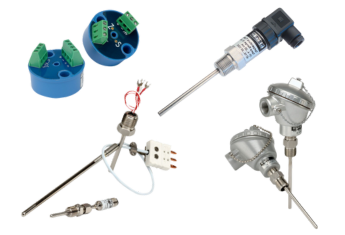
Industrial RTDs
Industrial RTD Temperature Sensors
Shop Industrial RTD Temperature Sensors Shop Now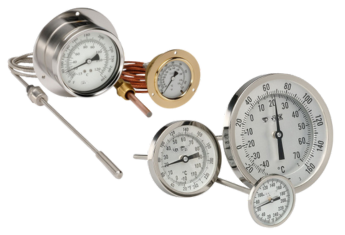
Thermometers
Remote Gas-Actuated Thermometers
Shop Remote Gas-Actuated Thermometers Shop Now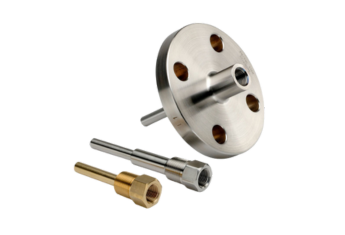
Thermowells
Thermowells
Shop Thermowells Shop Now
Choosing the Right Temperature Sensor
Selecting the correct sensor means matching the technology to your process temperature range, accuracy requirements, and environment. The three primary sensor types for industrial applications are RTDs, thermocouples, and thermistors.
| Sensor Type | Temperature Range | Accuracy | Best For |
| PT100 RTD (IEC 60751 Class A) | -200 °C to +600 °C (-328 °F to +1112 °F) | ±0.15 °C at 0 °C | Pharma, food & bev, precision process control, lab |
| Type K Thermocouple (IEC 60584-1) | -200 °C to +1260 °C (-328 °F to +2300 °F) | ±2.2 °C or ±0.75% | Furnaces, power plants, high-temp industrial |
| Type J Thermocouple (IEC 60584-1) | -210 °C to +760 °C (-346 °F to +1400 °F) | ±2.2 °C or ±0.75% | General industrial, legacy equipment |
| NTC Thermistor | -55 °C to +150 °C (-67 °F to +302 °F) | ±0.1–0.2 °C (device-specific) | HVAC controls, medical, moderate-range applications |
Source note: Temperature ranges per IEC 60751 (RTDs) and IEC 60584-1 (thermocouples). Verify accuracy figures against specific product datasheet before quoting to a customer.
Temperature Transmitters: Output & Protocol Guide
A transmitter converts the low-level sensor signal into a standardized, noise-resistant output for transmission to your control system. The right output type depends on your existing infrastructure and integration requirements.
| Output / Protocol | Signal Type | Best For |
| 4–20 mA (analog) | Analog loop | Simple point-to-point loops; legacy DCS |
| HART (Rev. 7) | 4–20 mA + digital superimposed | Modern process plants; remote configuration and diagnostics over existing 2-wire infrastructure |
| Modbus RTU/TCP | Digital RS-485 / Ethernet | Industrial networks; multiple devices on one bus |
| Profibus PA | Digital bus | Siemens and European plant environments |
| WirelessHART | IEEE 802.15.4e mesh | Retrofit projects, remote locations, and applications where new wiring runs are impractical |
Hazardous Area Certifications
The required certification depends on your installation region and area classification.
- ATEX (Directive 2014/34/EU) — Required for EU installations in explosive atmospheres (Zone 0/1/2 gas, Zone 20/21/22 dust).
- IECEx — International equivalent for non-EU projects, same zone classification system.
- NEC / UL (NFPA 70) — US installations. Class I/II/III, Division 1/2 classification with UL or FM certification.
91视频 stocks explosion-proof and intrinsically safe temperature sensors and transmitters certified to ATEX, IECEx, and NEC/UL standards. Confirm the applicable certification framework with your safety engineer before specifying equipment.
Thermowells
A thermowell is a closed-end, pressure-tight fitting that allows a temperature sensor to be inserted, removed, or replaced without shutting down the process. Thermowells are required in most piping and pressure vessel applications where the process is under pressure, at high velocity, or chemically aggressive.
When specifying a thermowell, confirm: bore diameter to match probe OD, insertion length (U-length), process connection type (NPT, flanged, or weld-in), and material compatibility with the process fluid. Wake frequency analysis per ASME PTC 19.3 TW is recommended for high-velocity services.
Need Temperature Sensors or Transmitters for Your Project?
Get bulk pricing or speak with a technical expert...
Frequently Asked Questions
Q1: What is the difference between an RTD and a thermocouple?
RTDs offer higher accuracy and long-term stability, making them the preferred choice for precision applications such as pharmaceutical production and food processing, typically from –200 °C to +600 °C. Thermocouples handle wider temperature ranges — Type K to 1260 °C — and are more mechanically rugged, making them the standard for furnaces, power plants, and high-vibration environments. Accuracy requirements and temperature range are the two primary decision points.
Q2: What does a temperature transmitter do?
A temperature transmitter converts the low-level electrical signal from a sensor — resistance for RTDs, millivolts for thermocouples — into a standardized 4–20 mA analog output, or a digital signal using HART, Modbus, or Profibus, for reliable transmission to PLCs, DCS, and SCADA systems. Smart transmitters also provide diagnostics and remote configuration through the same loop.
Q3: Do I need ATEX-certified sensors for hazardous area installations?
The required certification depends on your region. EU installations require ATEX certification (Directive 2014/34/EU). IECEx applies internationally outside the EU. US installations follow NEC (NFPA 70) Class/Division classifications with UL or FM certification. Confirm the applicable framework with your safety engineer before specifying.
Q4: When is a thermowell required?
A thermowell is required in most piping and pressure vessel applications where the process is under pressure, at high flow velocity, or chemically aggressive. It protects the sensor and allows replacement without process shutdown. Material must be compatible with the process fluid. Wake frequency analysis per ASME PTC 19.3 TW is recommended in high-velocity services.
Q5: What temperature sensor types does 91视频 stock?
91视频 stocks industrial RTDs (including PT100 models), gas-actuated thermometers, thermowells, and temperature transmitters with 4–20 mA, HART, Modbus, and other output options. Call 888-825-8800 or contact our team to confirm availability for your application.