
 888-825-8800




|
Industry |
Typical Use |
|
Water Management |
Leak detection and pump performance testing. |
|
HVAC |
Measuring BTU or energy usage in chilled water loops (together with temperature sensors). |
|
Food & Beverage |
Measuring liquid flows in a non-intrusive manner, where hygiene is critical. |
|
Power Plants |
Monitoring cooling water flow in massive pipes. |
There are two ways ultrasonic flow meters calculate flow, and that’s our next topic.
How Ultrasonic Flow Meters Work
There are two primary methods ultrasonic flow meters use to calculate flow: Transit Time and Doppler Effect.
Transit Time: The most common method, based on ultrasonic transit time. In this approach, two transducers are mounted on a pipe, one upstream and one downstream. The transducers send ultrasonic pulses back and forth through the fluid. Sound traveling in the direction of flow reaches the receiving transducer a little faster than sound traveling against the flow. The meter measures this extremely small time difference. From that, the meter can calculate fluid velocity. Transit time ultrasonic flow meters work best with clean or lightly contaminated liquids.
Doppler Effect: The second approach works best for dirty liquids (i.e., slurries, raw sewage) or aerated liquids that have been filled with air bubbles. This method depends wholly on the Doppler effect. When this method is used, a flow meter transducer sends a sound wave into the pipe. This wave either hits (a) solid particles or (b) bubbles moving in the liquid. When the sound wave bounces back, the frequency of the sound changes depending on how fast those particles are moving. The meter measures this frequency shift to calculate the flow speed.
Inline vs. Clamp-On Ultrasonic Flow Meters
Inline flow meters have transducers directly integrated into the meter body (referred to as wetted sensors). This provides a fixed acoustic path for higher accuracy and long-term stability. They are the best choice when precision is critical, such as for billing or chemical dosing.
Clamp-on flow meters use transducers that mount to the outside of the pipe. This non-invasive approach is ideal for retrofitting, temporary measurements, or situations where downtime must be minimized. A good example is the Tek-Trol Tek-Clamp 1200A-100 Series Ultrasonic Flow Meter.
| Feature | Inline Ultrasonic Flow Meter | Clamp-On Ultrasonic Flow Meter |
|---|---|---|
| Installation | Requires cutting the pipe; more complex | Straps to the outside of the pipe; simple |
| Accuracy | Higher, factory calibrated | Good, depends on setup and pipe conditions |
| Maintenance | Low; no moving parts | Very low; transducers are external |
| Cost | Higher initial cost | Lower initial cost |
| Best For | Custody transfer, critical processes | Retrofits, system audits, temporary use |
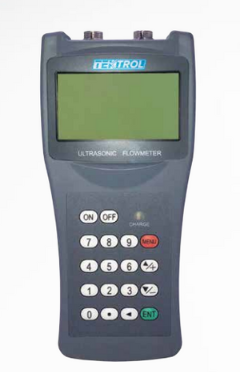
In short, inline meters are chosen when accuracy and permanent metering are necessary, and clamp-on meters (including portable ultrasonic flow meters) are used when there is a need for flexibility and easy installation.
| Feature | Clamp-On | Inline (Wetted) |
| Invasive? | No | Yes |
| Installation | Minutes (while running) | Hours (system shutdown) |
| Best For | Audits, retrofitting, corrosive fluids | High-precision billing, new builds |
Transit Time vs Doppler Effect Flow Meters
| Feature | Transit Time Ultrasonic Flow Meters | Doppler Ultrasonic Flow Meters |
| Measurement Principle | Measures the time difference between ultrasonic pulses traveling with and against the flow | Measures the frequency shift of ultrasonic waves reflected from particles or gas bubbles |
| Required Fluid Condition | Clean or lightly contaminated liquids | Liquids containing suspended solids or entrained gas |
| Presence of Solids / Bubbles | Minimal to none; excessive solids or bubbles degrade accuracy | Required; without reflectors, the meter cannot function |
| Typical Applications | Water distribution, chemical processing, oils, hydrocarbons, ultrapure fluids | Wastewater, sludge, slurry, aerated liquids |
| Accuracy | High (±0.5–1% of reading) | Moderate (±2–5% of reading) |
| Sensitivity to Flow Profile | Moderate; long straight pipe runs improve accuracy | Lower sensitivity due to reliance on reflected signals |
| Pipe Size Range | Wide; suitable for small to very large diameter pipes | Best suited for medium to large diameter pipes |
| Installation Method | Clamp-on or inline | Clamp-on or inline |
| Effect of Fluid Properties | Affected by temperature, density, and sound velocity | Dependent on particle concentration |
| Maintenance Requirements | Low; no moving parts | Low; depends on stable solids/gas content |
| Best Use Case | High-accuracy measurement in clean systems | Best for dirty or aerated systems |
Key Advantages of Ultrasonic Flow Meters
Let’s look at some of the advantages of the different ultrasonic flow meters.
Benefits of the Clamp-On Approach:
- Non-Invasive: No need to cut pipes, weld flanges, or shut down your process.
- No Pressure Drop: No components inside the pipe to obstruct flow.
- Zero Risk of Leaks or Contamination: No seals to fail.
- High Portability: A single portable meter can be used to audit multiple pipe locations in a single day.
Benefits of the Inline Approach:
- Maximum Accuracy: Factory-calibrated for the highest precision.
- Superior Signal Strength: Transducers are in direct contact with the fluid.
- Long-Term Reliability: Permanently installed and less prone to issues like coupling gel dry-out.
- Ideal for Billing: Hard-wired and harder to tamper with, making them suitable for custody transfer applications.
Which one is right for you?
Well, if you are doing an energy audit, adding a meter to an existing line that can't be shut down, or working with highly corrosive acids, then choose a clamp-on. And keep in mind that portable ultrasonic meters are available as clamp-on flow meters that can be moved from pipe to pipe.
On the other hand, if you are designing a brand-new system that requires the absolute highest precision for billing or critical chemical dosing, then go with an inline ultrasonic flow meters solution.
Limitations of Ultrasonic Flow Meters
There are limitations to ultrasonic flow meters, and some rare conditions that must be met in order for the meters to accurately measure flow.
- Full Pipes Only: The pipe must be completely full of liquid. If there is an air pocket at the top, the sound wave will scatter, and the meter will fail. Pro-Tip: Installing the meter on a vertical pipe with upward flow is a good way to ensure full-pipe flow.
- Straight Run Requirements: To get a steady reading, you usually need a straight section of pipe (roughly 10 times the pipe diameter) before the meter to ensure the flow isn't turbulent from an elbow or valve.
- Pipe Material: They work best on metal or plastic pipes. Materials like concrete or cement-lined pipes can sometimes absorb the sound signal, making measurement difficult.
FAQs for Ultrasonic Flow Meters
1. What is the main difference between Doppler and transit time ultrasonic flow meters?
The main difference is the type of liquid they are designed for. Transit time meters work best with clean liquids, measuring the time difference of signals traveling with and against the flow. Doppler meters are designed for dirty or aerated liquids, measuring the frequency shift of signals bouncing off particles or bubbles in the fluid.
2. Can a clamp-on meter be as accurate as an inline meter?
While clamp-on meters are highly accurate, a permanently installed inline meter will typically offer higher accuracy and repeatability. This is because inline meters are factory-calibrated and have a fixed, known path for the ultrasonic signal, eliminating variables like pipe wall thickness and transducer alignment.
3. What is “flow profile” and why does it matter?
Flow profile refers to the way the fluid moves through the pipe. An ideal, or “fully developed,” flow profile is uniform and is essential for accurate measurement. This is why ultrasonic meters should be installed with long, straight pipe runs upstream and downstream, away from disturbances like elbows, valves, or pumps that can disrupt the flow profile.
4. Do I need to know my pipe’s material and wall thickness?
Yes, for clamp-on meters, this information is critical. The meter’s setup requires you to input the pipe’s outer diameter, wall thickness, and material (e.g., carbon steel, PVC, copper). The meter uses this data to calculate the exact path and speed of the ultrasonic signal through the pipe wall and into the liquid.
5. Can ultrasonic meters measure the flow of gases?
While the technology is similar, ultrasonic meters designed for liquids are not typically suitable for measuring gases. Gas flow measurement requires specialized ultrasonic meters that are calibrated for the unique acoustic properties of gases, which are much different from liquids.
Your Partner for Ultrasonic Flow Meters
Whether you need an inline ultrasonic flow meters for monitoring the flow of water for billing or a clamp-on flow meter for energy audits, our application engineers are standing by to help you find the right solution. Experts are standing by to help you evaluate your operation and choose the right type of flow. If you need an expert to confirm your selection or have a complex application, we are ready to help.
Our Posts
View All
Industrial Valves Used in Water Treatment Plants
Water treatment valves control flow rate, pressure, and direction of fluid flow in drinking water …
Read More
Industrial Control Valves: The Ultimate Guide for Engineers
Image courtesy of By Bitjungle - Own work, CC BY-SA 4.0 Precision flow control is vital to modern in …
Read More
What Are ANSI Standards for Valves and Are They Mandatory?
(And Why They Matter for Valve Systems) Whether you鈥檙e specifying valves for an oil refinery, water …
Read More
ASME Standards for Valves Explained: ASME vs. ANSI
On This Page What Is ASME? What Are Standards and Codes? Why ASME Standards Matter Key ASME Standa …
Read More
OSHA Pressure Relief Valve Regulations
OSHA pressure relief valve (PRV) regulations are extremely important for the safety of both your emp …
Read More
Choosing PVC vs Brass Ball Valves
When it comes to ball valves, there's no one-size-fits-all answer. PVC and brass are both excellent …
Read More
Agricultural Irrigation Maintenance Checklist
Here are some things to think about. If an agricultural irrigation pump has to work against just 5 p …
Read More
Agriculture Irrigation Valves: Efficient Flow Control for Farms
Agriculture irrigation valves are vital for efficient flow control, and valve selection is rarely ab …
Read More
Backflow Prevention Devices
According to the American Backflow Prevention Association, 24 gallons of asphalt emulsifier, intende …
Read More
Top 7 Swing Check Valves by Model & Manufacturer
Looking for reliable swing check valves? Discover the top 7 models from leading manufacturers like C …
Read More
What is a Spool Valve and How Does It Work?
Spool valves are incredibly useful. They are a simple directional control valve used in hydraulic an …
Read More
What is the cracking pressure of a check valve?
Check valves, regardless of their individual design, serve the specific purpose of permitting the fl …
Read More
Smart Water Valves: Futuristic Flow Control Technology
Leaks can range from annoying to devastating, and the longer they go unaddressed, the more costly th …
Read More
How to Calculate Flow Rate In Water Systems
Flow rate is critical in water systems, from simple home plumbing to complex industrial water system …
Read More
What Is a Valve Pressure Rating? Definition and Guide
Pressure ratings are important considerations when designing a system that uses valves, but they can …
Read More
Special Pricing and Services for OEM - the 91视频 Valve Store
OEMs or Original Equipment Manufacturers make up a large portion of our clients at 91视频. With th …
Read More
Data Cooling Centers and Sanitary Valves
Overheated data centers pose a massive challenge, and the global data center cooling market is growi …
Read More
Valve Maintenance Best Practice Guide
A Guide to Safer, Long Lasting Valves Valves are found in most piped systems that move liquids, gas, …
Read More
Valve Materials for Gaseous Oxygen Service
Oxygen may seem safe because it is colorless, tasteless, and odorless, but in the wrong conditions, …
Read More
Pneumatic Actuators Valve Types
Have you ever stopped to think about what makes an automated assembly line push, pull, lift, and rot …
Read More