
 888-825-8800




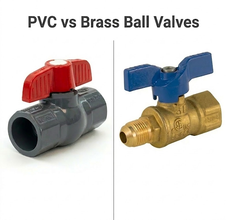
Choosing PVC vs Brass Ball Valves
Posted by Gilbert Welsford, Jr on Mar 26th 2026
When it comes to ball valves, there's no one-size-fits-all answer. PVC and brass are both excellent options, just for very different reasons. One is lightweight, budget-friendly, and corrosion-proof for many fluids. The other is built tough for heat, pressure, and the long haul. So which one belongs in your system? Let's walk together through the pros and cons of each so you can decide with confidence.
Ball Valves
Ball valves are used to stop, start, or regulate fluid flow, and are known for both their durability and excellent sealing. They are practically ubiquitous in the plumbing industry, and their functionality is very simple: these valves house a ball with a hole through the center. When the hole aligns with the pipe, fluid flows. When the hole doesn’t align with the pipe, there is no flow. A lever, handle, or actuator is used to control the position of the ball element.
Pros and Cons of PVC Ball Valves
PVC ball valves are made from thermoplastic PVC, which doesn’t rust and is highly resistant to many chemicals. This is part of the reason they are a popular choice for systems that include chemicals, irrigation, and water treatment plants, where other metal valves are likely to degrade. An example would be the valve below: a schedule 40, 150 WOG Jomar S-702 series PVC ball valve.

PVC ball valves also tend to be much more cost-effective compared to brass ball valves. In fact, they can easily cost up to 60% less than equivalent brass ball valves. Because they are cost-friendly, they are ideal for situations where the budget is sensitive or a large-scale solution is needed.
PVC ball valves are also known for their ease of installation. They are lightweight, and no specialized training or tools are needed to install them. This, in turn, can significantly reduce labor costs compared to other valve solutions. In addition, these valves are very low-maintenance over their service life. They do, however, need to be inspected periodically because they can seize if left in one position for extended periods.
PVC ball valves are excellent in environments where toxic or harsh chemicals are involved. Many engineers don’t realize that PVC is often considered a safer alternative to metal, specifically because they reduce the risks of leaks due to corrosion. Finally, PVC ball valves provide smooth control with a minimal pressure drop across the valve itself.
There are drawbacks to using PVC ball valves. For example, they are much more sensitive to heat than their brass counterparts. More specifically, they aren’t recommended for applications exceeding 100°F to 120°F (38°C to 49°C). In fact, in high-heat applications, there is the possibility that PVC valves can burst in the presence of sudden heat spikes. Their sensitivity to heat spikes makes them highly risky for use with steam and other high-heat lines. PVC ball valves also have a lower pressure tolerance, as they are suited primarily for low to medium pressure systems as opposed to high-pressure operating environments or heavy-duty industrial lines.
PVC ball valves are also susceptible to problems like cracking or breaking when exposed to physical impact, over-tightening during installation, or vibration. In such operating conditions, metal valves are going to be a better choice.
PVC ball valves also have a shorter life span compared to brass valves. A brass valve can easily last around 20 to 50 years, whereas PVC valves are usually limited to 5 to 15 years. Keep in mind that the working life of valves depends heavily on factors such as process fluid, pressure and temperature, and operating environment.
PVC is also sensitive to UV, which means prolonged exposure to UV radiation and direct sunlight can compromise the lifespan of PVC ball valves.
Pros and Cons of Brass Ball Valves
Brass ball valves are primarily known for their excellent durability and strength. Compared to PVC ball valves, brass ball valves exhibit excellent resistance to physical impact and mechanical stress, including physical impact and vibration. Below is a good example: the Apollo 94A-200, rated at 600 CWP and available in 1/2" to 4".

Unlike PVC ball valves, brass ball valves are engineered for outstanding performance in high-pressure environments. You’ll often see them rated for temperatures up to 250–300°F (121–149°C) and significantly higher pressure systems than PVC. They are ideal for hot water and heavy-duty industrial pipelines.
When brass ball valves have been properly maintained, their service life is usually between 20 and 50 years. Because of this, they are usually viewed as long-term investments for the most critical systems, where the frequent replacement of valves is not ideal.
In terms of chemical resistance, brass exhibits excellent compatibility with fluids such as natural gas, water, and oil. They are also excellent for potable water systems if lead-free brass alloys are used.
There are drawbacks to brass ball valves, though. They can cost up to 60% more than an equivalent PVC ball valve. The valve ball and seats usually need to be lubricated with grease or oil to maintain smooth operation and, to some degree, prevent surface degradation.
Brass ball valves are resistant to corrosion but are vulnerable to acids, chlorides, and high chlorine levels. Over time, brass will experience dezincification in the presence of chlorine, which weakens the valve body. And if these valves are not maintained properly, they can rust or erode over time.
Brass is much heavier than PVC, which can make installation more challenging (and expensive) than PVC ball valves, and more pipe support is needed when brass ball valves are used.
Finally, unlike the practically maintenance-free PVC ball valves, brass ball valves do require regular maintenance, including cleaning and lubrication.
Summary
The table below summarizes the differences between PVC ball valves and brass ball valves.
| Category | PVC Ball Valves | Brass Ball Valves |
| Durability & Strength | Susceptible to cracking from impact, over-tightening, and vibration | Excellent resistance to physical impact, mechanical stress, and vibration |
| Temperature Rating | Up to 140°F (60°C); risk of bursting under sudden heat spikes | Up to 250–300°F (121–149°C); ideal for hot water |
| Pressure Rating | Low to medium pressure systems only | Significantly higher pressure tolerance |
| Service Life | 5–15 years | 20–50 years with proper maintenance |
| Chemical Compatibility | Excellent for corrosive chemicals, irrigation, and water treatment | Compatible with natural gases, water, and oil; suitable for potable water with lead-free alloys |
| Chemical Vulnerabilities | Degraded by UV exposure and prolonged sunlight. Not suited to organic solvents, some hydrocarbons, halogens, and concentrated acids | Susceptible to acids, chlorides, and high chlorine levels; risk of dezincification |
| Cost | Up to 60% less than equivalent brass valves | Higher upfront cost |
| Weight & Installation | Lightweight; no specialized tools or training required | Heavier, more challenging, and expensive to install; requires more pipe support |
| Maintenance | Practically maintenance-free | Requires regular cleaning and lubrication |
| Best For | Corrosive chemicals, irrigation, water treatment, and budget-sensitive projects | Steam lines, high-pressure systems, and long-term critical applications |
Conclusion
Do you need a PVC or brass ball valve? Well, if you have questions, the Valve experts here at 91视频 are ready to put over 65 years of experience to work for you. We can help you find the right ball valve for your application. Contact us today.

Gilbert Welsford, a renowned valve industry expert and third-generation owner of FS Welsford Company, is the visionary behind 91视频, a leading platform for valve-related products. Gilbert's profound understanding of fluid dynamics and precision engineering plays a pivotal role in designing and applying various valve types. Known for his collaborative approach and outstanding communication skills, he builds strong relationships across multiple sectors and consistently ensures successful project outcomes. Committed to innovation and excellence, Gilbert remains at the forefront of industry advancements, consistently delivering solutions that exceed expectations.