
 888-825-8800




Industrial Control Valves: The Ultimate Guide for Engineers
Posted by Gilbert Welsford, Jr on May 20th 2026
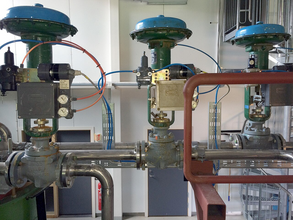
Image courtesy of By Bitjungle - Own work,
Precision flow control is vital to modern industry, and the is often the final and most critical element in any process control loop. To help you better understand control valves, 91视频 created this guide based on over 65 years of experience in the valve industry. Here you’ll learn about the fundamental principles of control valves and the various types available, along with how to select them and what their most common applications are.
What is a Control Valve and Why is it Critical?
A control valve is a device used to control and modulate fluid flow. In a process control system, the control valve is the physical device that implements the controller’s commands. While the controller may make all the decisions, it’s the control valve that makes those decisions a reality. Control valves serve several functions in flow control. Let’s look at those.
Starting and Stopping Flow
First, they are responsible for starting and stopping the passage of fluid. A control valve can completely shut off flow when the valve plug is firmly pressed against the valve seat. Such valves can be categorized by their de-energized states.
Regulating Flow Rate (Throttling)
Another key function of a control valve is throttling. Many valves need to be capable of more than just opening and closing to precisely regulate the flow. This is referred to as throttling and is accomplished by modulating the flow area. Modulation is achieved through the valve moving its closure element to adjust the flow area and how much fluid can pass through the valve.
Throttling integrates with the fluid control system through continuous adjustment: the valve receives a signal from a controller and converts it into the valve motion needed to manipulate the fluid flow until the flow rate is correct. The capacity of a valve to regulate flow is measured by its flow coefficient, Cv. The flow coefficient indicates how many gpm can pass through the valve at a specified pressure drop when the valve is fully open.
Controlling Pressure, Temperature, or Liquid Level
The ultimate goal of a control valve is often to manage a specific process variable to keep it within a required operating range. This can include controlling the pressure, the temperature, or the liquid level. Because flow speed, pressure, and temperature are interrelated in fluids, adjusting the flow rate can influence pressure and temperature, and this can be very important in many industrial applications. And it makes sense that the flow rate is going to be related to the liquid level as well, making it possible to have a desired setpoint that is precisely regulated.
By performing these various functions, control valves ensure optimal operating conditions, leading to improved efficiency, safety, and product quality.
The Core Components of a Control Valve Assembly
Now that we’ve discussed the functions of a control valve, let’s talk about its anatomy. First, let’s look at a manual ball valve.

Valve Components
These parts are responsible for managing the actual fluid movement. Included are the …
- Ball: The ball is the movable part that sits on the end of the valve stem. It rotates to allow flow or block it.
- Seats: The seats are the stationary part of the valve body that the ball presses against to form a seal. If the ball and seat don't align perfectly, then you’ll likely have a leaky valve.
- Stem: The stem is a rod that connects the handwheel to the ball. It is responsible for transmitting the mechanical force needed to open or close the valve. At the top of the stem, you’ll find the handle used to rotate the ball.
- Ports: This is where the fluid enters and exits the valve.
The Actuator
In a control valve setup, the manual handle is replaced by an actuator. Think of the actuator as the "muscles" of the system; it receives a signal from a controller and provides the physical force to move the valve stem to a specific position. There are three types of valve control actuators:
- Pneumatic Actuators: This is the most common type of actuator used in industrial settings due to their reliability, high force capability, and "fail-safe" options. Pneumatic actuators use compressed air to move a diaphragm or piston.
- Hydraulic Actuators: These operate similarly to pneumatic actuators but use an incompressible fluid, like oil, instead of air.
- Electric Actuators: These use an electric motor and a gear assembly (when needed) to convert rotational motion into the linear motion needed to adjust the position of the valve stem.
The figure below summarizes the actuators.

A Comprehensive Breakdown of Control Valve Types
Control valves can be categorized in many ways, one of them being based on the type of motion they implement: either linear or rotary.
Linear Motion Control Valves
Let’s talk about linear motion control valves first. There are multiple types: globe, needle, gate (for isolation only), and diaphragm valves.
Globe Valves

Engineers often consider these the gold standard for high-precision throttling. In a globe valve, the fluid makes a 90-degree turn as it passes through the seat, allowing very fine control of the flow area. Because the plug moves perpendicular to the seat, the distance between the plug and the seat can be adjusted with great precision to control the flow. Globe control valves offer high accuracy and excellent shut-off, as well as the ability to handle high-pressure drops. However, globe valves do have issues with high pressure loss and they tend to be heavy and bulky.
There are three body styles for globe valves:
- T-Body: This is the most common, but it causes a high-pressure drop because of the "S" shaped flow path.
- Y-Body: In this body type, the stem is angled at 45°, which straightens the flow path to achieve a reduced pressure loss and less erosion while maintaining excellent throttling capabilities.
- Angle-Body: This body type turns the flow 90 degrees and has been found ideal for flashing fluids or high-pressure drops where the fluid might otherwise damage the piping.
You’ll find globe valves used with chemical injection systems, cooling water systems, and boiler feed water. The image below is a Steriflow FBCV-OR Sanitary Globe-Style Control Valve specifically engineered for food and beverage use only. The body, stem, and bonnet are 316 SS while the seal material can be chosen from FDA EPDM, FDA Viton, FDA Silicon, Kalrez, or Fluoraz/ Buna-N.

Needle Valves
Needle valves provide fine tuning of flow control, and its defining feature is a tapered, needle-like plunger. As the valve wheel is turned, the needle slowly moves in or out of the conical seat, which means incredibly minute adjustments can be made to the fluid flow rate. In addition, because of its small orifice and fine threaded stem (which provides significant mechanical advantage), the needle valve is ideal for handling high-pressure fluids.

Needle valves are often used to protect precision instrumentation such as pressure gauges and pressure transmitters. You’ll also see them used with gas chromatography and chemical sampling. In the oil and gas industry, they are ideal for setting up sampling points as well as chemical injection points. You’ll also see them used with carburetors, vacuum systems, and hydraulic systems. Large diameter needle valves may be used for water management at dam outlets.
Shown below is a NOSHOCK 100 Series 1/8" NPT, Brass, Hard Seat, Mini Needle Valve with a body manufactured from Zinc-nickel plated steel, electropolished 316 stainless steel, and 360 brass. This NOSHOCK valve also has 316 stainless steel stems with FKM o-ring and PTFE back-up ring below the threads, PTFE or Grafoil® packing optional. These mini valves have a Cv = 0.42 and are available in 鈪� and ¼ in sizes.
Gate Valves


Image courtesy of
Gate valves, such as the ones shown below, stop the flow of fluid by raising or lowering a flat gate into open or closed position. Such valves are designed for isolation, not flow control or regulation; they are slow to open and will vibrate if partially open. When open, the gate is fully retracted and offers a straight-through path with a low pressure drop. However, if used partially open, the high-velocity fluid will slam violently against the bottom of the gate, causing it to vibrate (chatter) and erode the seating surfaces.

These valves are often found in main water shut-off lines and oil/gas pipelines. The valve below is a SVF Flow Control 430CSF Gate Valve. The body and trim are cast steel and it is rated for a maximum pressure of 740 psi and a maximum temperature of 1000°F.
Diaphragm Valves
These linear valves use flexible elastomeric diaphragms that are pushed down to meet the valve seat or weir. The diaphragm acts as a total seal that isolates the process fluid from the operating mechanism (stem/actuator). This prevents fluid contamination and prevents corrosive fluids from damaging the valve internals. Diaphragm control valves are hygienic and easy to clean, but they do have limited pressure and temperature ranges.
Diaphragm valves are often used in applications where sanitation is critical, such as pharmaceutical manufacturing and food processing, as well as demanding applications like chemical slurries. Below is a Steriflow air loaded back-pressure diaphragm regulator. It is made from 316 stainless steel with a Jordan diaphragm.

Rotary Motion Control Valves
Next, we have rotary motion control valves, of which there are also three types: ball, butterfly, and plug valves.
Ball Valves
Ball valves have a spherical ball with a hole through the center, and a 90-degree turn moves the valve from fully open to fully closed. These are extremely versatile and offer the tightest shut-off of any valve type, but they are difficult to throttle precisely at low openings and are prone to issues with cavitation.

There are two types of mounting for ball valves:
- Floating: In this type, the ball is held by the seats and floats downstream slightly under pressure to improve the seal. Floating ball valves work best for smaller, lower-pressure lines.
- Trunnion-Mounted: In this type, the ball is fixed on a vertical pivot (known as a trunnion). This prevents the ball from moving, which makes it easier to turn the valve under extreme high pressure.
Ball valves work well for high-flow, on-off applications. They are primarily used in high-capacity industrial applications, such as oil and gas transmission or pulp and paper processing. In such applications, their ability to provide a straight-through flow path makes for a more efficient and clog-resistant alternative to globe valves.
Segmented ball valves, also known as V-port ball valves, are high-performance valves designed specifically for throttling and modulating flow as opposed to merely on-off applications. Instead of a simple ball or sphere, they have a segmented ball, that is a ball with a specially profiled opening that usually takes the form of a V-notch. The V-notch serves as a small, precise opening as the ball turns against the seal. As the ball valve continues to rotate, the opening increases in a highly predictable way that allows the flow of fluids to be controlled with a high level of control.
Here’s a summary of how standard ball valves and segmented ball valves compare.
Segmented ball valves are used in a number of applications, including wastewater treatment, chemical processing, pulp and paper, and oil and gas.
The standard ball valve shown below is a Bonomi M8E065LF-00 Series Ball Valve with a metal electrical actuator. Most of this valve is made from lead-free brass with a PTFE seat. It is pressure-rated at 400 psi WOG and has a temperature range from -4°F to 366°F.

Shown below is a segmented ball valve, a 2" Bonomi PP710190V**DA 30/ 60/ 90° V-Port Ball Valve with a pneumatic actuator. This 2-way stainless steel V-port ball valve body and ball is manufactured from AISI 304-CF8M cast stainless steel. It is available with ball options that include 30° - 60° , 60° , and 90°.

Butterfly Valves
Butterfly valves have a simple circular disc that rotates on a shaft in the center of the pipe. These valves are lightweight and very thin, making them the most cost-effective choice for large-diameter pipes (greater than 8” diameter). However, butterfly valves require quite a bit of torque to turn.

There are two styles of butterfly valves:
- Concentric: Concentric style means the shaft is centered. This is a cheaper model of a butterfly valve, but the disc is always going to be in contact with the seat, which leads to high wear.
- Eccentric: In this style, the shaft is "offset" from the center. This design allows the disc to cam into the seat only at the final moment of closure. This drastically reduces wear and makes higher pressure ratings possible. Both double and triple eccentric (high-performance) butterfly valve designs are available.
Ideal for large volume, low-pressure flow, butterfly control valves are primarily utilized for isolation and shut off in large-scale water, HVAC, and power generation systems. There, they serve as a lightweight, cost-effective solution for isolation. In addition, high-performance butterfly valves can be used for direct flow control, but are not suited to control at low opening percentages.
Shown below is a Bonomi ME9101-00 Series butterfly valve with a metal electric actuator. It’s manufactured from CF8M Stainless Steel with PTFE packing material. It is rated for 275 psi and -4°F to 131°F.
Plug Valves
This is one of the oldest valve designs and is excellent for severe service applications. Plug valves have a tapered or cylindrical shape, with a hollow passage through the plug. They are similar to ball valves but with a much larger seating area, which makes them incredibly durable and suited for dirty services involving solids and slurries. However, they tend to be high-friction and require quite a bit of torque to turn. Note that these valves are also available as multi-port valves (3-way or 4-way) to divert or redirect flow from one pipe to another.

Plug valves are typically used in severe-service applications, such as mining slurries, corrosive chemical processing, and high-pressure oil production, where their robust design and large seating area provide exceptional durability and reliable shut-off in abrasive environments. There, they are suitable for isolation and shut-off applications. However, there are special plug valves, such as eccentric-shaped plug valves or profiled diamond-shaped ports, that can be used for moderate flow control, but not for precise control or high throttling.
The image below is a Sanitary Solutions SS11MPR3WAY rubber plug valve engineered for low-pressure performance under 25 psig and low temperatures up to 95°F.

Summary of Control Valve Types
Here’s a table summarizing the types of control valves, including what they’re best for and their major strengths/weaknesses.
Ready to Find the Right Control Valve?
91视频 stocks globe, ball, butterfly, plug, and diaphragm control valves across thousands of configurations — with in-house engineers ready to help you specify the right valve for your exact application.
Browse Control Valves → Request Bulk PricingControl Valve Selection: Key Criteria for Engineers
Here are some guidelines and a checklist to help you find the right control valve for your application.
Understanding Process Conditions
Let’s talk about process conditions. Before choosing a valve, you must define the environment in which it will operate; for example, we know that a basic water valve operates very differently from one handling high-pressure steam or abrasive mining slurry. So here’s what to consider:
- Fluid Type: Is it a clean liquid, a gas, or a multi-phase fluid (i.e, liquid with bubbles or solids)? This dictates, for example, whether you can use a standard globe valve or if you need a shearing valve like a segmented ball valve.
- Temperature: High temperatures cause metals to expand and soften, potentially leading to seizing. And that can prove disastrous in many applications. High temperatures also influence seat and seal material selection. Cryogenic temperatures, on the other hand, usually require extended bonnets to keep the packing from freezing.
- Pressure Profile: You also need to know the inlet pressure (P1), the outlet pressure (P2), and the vapor pressure of the fluid. If the pressure drops too low inside the valve, you’re running the risk of cavitation, which can destroy a valve in hours.
- Flow Rates: Remember to always specify the Minimum, Normal, and Maximum expected flow. A valve that is spec’ed for control at Maximum flow might be impossible to control during Min flow conditions.
Now that we have this information on hand, let’s talk about how to size the valve.
Control Valve Sizing: The Importance of the Flow Coefficient (Cv)
Another critical aspect of designing control valves is the flow coefficient Cv, introduced in the video below.
In simple terms, Cv is the capacity of the valve. It is defined as the number of U.S. gallons of 60°F water that will flow through a wide-open valve per minute with a pressure drop of 1 psi over the valve. Calculating the flow coefficient (Cv value) is crucial for choosing the right size valve for a specific application, to ensure efficient performance and safe operation.
Control valve sizing methodology is standardized by the under standard ISA-75.01.01, which defines the equations and procedures for calculating Cv across liquid, gas, and two-phase flow applications.
Let’s talk about why control valve sizing is so important. If you select a valve that is too large, it will operate close to the seat (less than 10% open). This leads to hunting (instability) and wire-drawing, where the high-velocity fluid erodes the seating surface. An undersized valve acts as a bottleneck: even at 100% open, it won't allow the process to reach its required capacity, potentially stalling your entire production line.
Here’s the typical workflow for determining the Cv:
- Determine Process Data: You need the flow rate (Q), the pressure at the valve inlet (P1), and the desired pressure at the outlet (P2).
- Calculate Required Cv: Use the formulae below to find the Required Cv.
- Apply Safety Factors: Typically, you select a valve with a Rated Cv (its max capacity) that is about 1.3 to 1.5 times your calculated Cv.
- Check Operating Range: Next, ensure your Normal flow occurs when the valve is between 20% and 80% open. If the valve is only 5% open during normal operation, it’s oversized and will vibrate and wear out quickly.
To help you with determining the Cv, 91视频 has a . The figure below shows what the 91视频 Cv calculator looks like. Note that you can download a report of the results, which is very helpful when documenting the design process. Based on the information you provide, the calculator chooses the applicable formula and performs the needed calculations.

Flow Characteristic: Linear vs. Equal Percentage
Choosing a control valve with the correct flow characteristic is critical: it ensures the control loop remains stable and provides precise control despite changes in system pressure, by ensuring the controller has a consistent effect on the process at any valve position.
For valves with a linear flow characteristic, the flow capacity increases in direct proportion to the valve travel, as illustrated in the figure above. If the valve is 50% open, it provides 50% of its total flow capacity. This works best with level control or systems where there is a constant pressure drop across the valve.
Valves with equal percentage flow characteristics work like this: for every equal increment of valve travel, the flow changes by an equal percentage of the previous flow. You’ll find this used with most process control loops, and it works extremely well when the pressure drop over the valve decreases as flow increases (as is often the case with long piping runs).

Material Selection
The longevity of the valve depends on matching its metallurgy to the process fluid and operating conditions.
- Body Materials:
- Carbon Steel (): This is the industry standard for non-corrosive fluids like steam, water, and oil up to 800°F.
- Stainless Steel (/): This alloy of stainless steel resists corrosion from chemicals and is essential for high-purity or "clean" applications. Other versions of stainless steel such as duplex and super-duplex stainless steel are available for harsh chemicals.
- Trim Materials (Plug and Seat):
- Since valve trim faces the highest velocity, it is often made of harder materials than the body. Stellite is frequently used to "face" the seat and plug to prevent wear in high-pressure drop services (for example, the AVCO 1100 series ball valve).
- Compatibility: We recommend that you always check a Corrosion Resistance Table such as this one for . For example, while Stainless Steel is great for many things, highly concentrated Sulfuric Acid might require Hastelloy or a Teflon (PTFE) lining.
Fail-Safe Position: Fail-Open or Fail-Closed?
When the compressed air or electricity is lost, the valve must move to a position that prevents a catastrophe. This is usually achieved via a heavy internal spring in the actuator.
- Fail-Closed (FC): The spring pushes the valve shut, and this works extremely well for steam or fuel lines. In such lines, you want to stop the energy input if the control system fails.
- Fail-Open (FO): The spring pushes the valve fully open, which is ideal for Cooling Water or Relief Lines. If the system fails, you want maximum cooling to prevent an over-temperature event.
- Fail-Last (FL): The valve remains in its last known position when the signal is lost, which is a common requirement in certain complex digital or electric systems.
Checklist
Here’s a checklist for control valve selection.
A printable one-page checklist covering every critical decision point — process conditions, Cv calculation, flow characteristics, material selection, and fail-safe mode. Used by process engineers across 40+ industries.
Control Valve Applications
Here at Valveman, we support the entire energy value chain, from providing high-pressure gate valves for wellhead extraction to specialized ball valves for pipeline transport and refinery processing. Our inventory of industrial control valves is engineered to withstand the volatile environments and adhere to critical safety standards required for crude and gas handling.91视频 also offers corrosion-resistant alloys and PTFE-lined solutions for environments with aggressive media and hazardous chemical reactions. We help facilities of all sizes to maintain precise flow control while maintaining environmental compliance and leak prevention.

Image courtesy of
Our heavy-duty valves manage the extreme temperatures and pressures inherent in steam turbine cycles and cooling water systems. 91视频 provides what you need to prevent costly downtime in both traditional fossil fuel plants and nuclear environments. From municipal filtration to industrial effluent management, 91视频 has durable control valves that are designed to reliably handle high-volume flow and rigorous disinfection protocols effectively.
We offer a range of sanitary-grade valves that meet strict FDA and 3-A standards for hygiene and clean-in-place (CIP) compatibility that ensure product purity and prevent cross-contamination during high-speed processing and packaging.
Our team here at 91视频 also provides efficient control valves and actuators that optimize thermal distribution in large-scale commercial buildings and city-wide heating networks. These systems are designed to maximize energy efficiency and maintain consistent climate control across vast infrastructure.
Partner with the Valve Experts
Selecting the right control valve is an engineering decision that directly impacts the safety, operational efficiency, and final product quality of your entire system. Beyond providing premium hardware, our team here at 91视频 serves as your dedicated technical partner, offering the deep industrial expertise required to navigate complex specifications and ensure long-term performance.
Frequently Asked Questions About Control Valves
What is a control valve?
A control valve is a power-operated device that regulates the flow of fluids — liquids, gases, or slurries — in response to a signal from a process controller. It is the final control element in a control loop: when your PID controller decides to change a setpoint, the control valve is the physical device that makes it happen. Control valves regulate flow rate, pressure, temperature, and liquid level across virtually every industrial process.
What are the main types of control valves?
Control valves fall into two motion categories. Linear motion valves — including globe, gate, needle, and diaphragm valves — use a sliding stem. Rotary motion valves — including ball, butterfly, and plug valves — use a quarter-turn mechanism. Globe valves are the industry standard for precision throttling. Ball and butterfly valves are preferred for high-flow on/off and large-diameter applications.
How is a control valve sized?
Control valve sizing is based on the flow coefficient (Cv) — the number of US gallons per minute of water that passes through the valve at a 1 psi pressure drop. Engineers calculate the required Cv using process data (flow rate, inlet/outlet pressure, fluid properties) and select a valve whose rated Cv allows normal operation between 20–80% open. Use 91视频's free Cv calculator to size your valve in minutes.
What is the difference between fail-open and fail-closed?
A fail-closed (FC) valve shuts completely when it loses its control signal or power — used on steam, fuel, and hazardous fluid lines where uncontrolled flow is dangerous. A fail-open (FO) valve opens fully on loss of signal — used on cooling water, relief, and temperature-sensitive lines where flow must be maintained for safety. The correct fail-safe position is determined by process hazard analysis (PHA).
What is the difference between linear and equal percentage flow characteristics?
A linear characteristic delivers flow in direct proportion to valve travel. An equal percentage characteristic delivers a consistent percentage change in flow per increment of travel, providing finer control at low openings. Most process control applications use equal percentage valves because the pressure drop across the valve changes with system flow rate.
What industries use control valves?
Control valves are used across oil and gas (upstream, midstream, downstream), chemical and petrochemical processing, power generation (steam and cooling systems), water and wastewater treatment, food and beverage manufacturing, pharmaceutical production, and HVAC and district energy systems. Their function in all of these is to precisely regulate fluid flow, pressure, temperature, or liquid level within a process control system.
Have a Complex Control Valve Application?
Our team of valve engineers has sized and specified control valves for oil & gas, chemical processing, power generation, and more. Tell us your process conditions and we'll recommend the right valve — fast.
Talk to a 91视频 Engineer →No obligation. Same-day response on most inquiries.
A control valve is a power-operated device that regulates the flow of fluids — liquids, gases, or slurries — in response to signals from an automatic controller. It is the final control element in a process control loop: when your PID controller decides to change a setpoint, the control valve is the physical device that makes it happen. Control valves regulate flow rate, pressure, temperature, and liquid level across virtually every industrial process.

Gilbert Welsford, a renowned valve industry expert and third-generation owner of FS Welsford Company, is the visionary behind 91视频, a leading platform for valve-related products. Gilbert's profound understanding of fluid dynamics and precision engineering plays a pivotal role in designing and applying various valve types. Known for his collaborative approach and outstanding communication skills, he builds strong relationships across multiple sectors and consistently ensures successful project outcomes. Committed to innovation and excellence, Gilbert remains at the forefront of industry advancements, consistently delivering solutions that exceed expectations.