
 888-825-8800




Globe valves are a type of linear motion control valve used for regulating or 'throttling' fluid flow, as well as for stopping and starting flow in a pipe system. Globe valves are ideal for applications that require precise flow control, and may also be used to shut-off flow.
How do Globe Valves Work?
Modern globe valves typically comprise a valve body with a spherical or 'globe' shape, a bonnet which seals the valve body and houses the stem, and a valve plug (or disk) at the end of the stem, which moves up and down as the valve is actuated, and seals against a stationary valve seat.
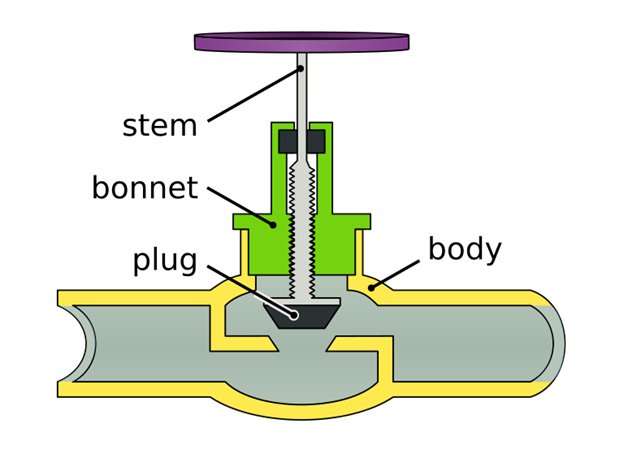
Globe valves are designed to regulate flow. As the plug is raised or lowered, it changes the size of the opening through the valve, allowing for precise control of the fluid flow rate. Once the disc is seated firmly against the stationary ring seat, it creates a leak tight seal, which minimizes leakage across the fully closed valve.
Globe valves develop a tortuous fluid flow path through the valve body, which creates a relatively high pressure drop across the valve. This energy loss is required to provide the valve's enhanced flow control and throttling capability.
Similar to other linear motion valves, such as gate valves, globe valves have relatively slow operation as multiple turns of the handwheel or actuating device are needed to open or close the valve. On the plus side, this slow valve opening and closure may help to prevent pressure surge or 'water hammer' effects. Globe valve designs are generally bulkier than ball valves and butterfly valves of comparable size.
Globe Valve Designs
Globe valves are available in three main body designs. These are wye pattern, tee pattern (also called Z-pattern), and angle pattern valves.
Angle valves modify the flow path by 90 degrees, with the valve acting as a combined control valve and elbow, eliminating the need for a separate elbow in the pipework.
Z-type globe valve designs are common, where the stem and plug move perpendicular to the pipe axis. This creates a large pressure drop across the valve.
Y-pattern valves provide an angled internal flow path, where the stem and seat positioned at a 45-degree angle to the pipe axis. This creates a straighter flow path and reduces pressure drop across the valve.
Globe valves may be distinguished further by valve size, pressure rating, end connection, port type (full port or reduced port), disc element (plug, tapered plug, ball, or composite disc), bonnet (bolted, welded or threaded), type of stem (rising and non-rising stem, integrated and non-integrated disk, outside screw and yoke - OS&Y), valve trim and material options.
More on globe valve discs
Globe valves are available with different styles of discs. The most common options include:
Plug disc: The plug disc design consists of a solid, tapered disc with a plug-like shape. The plug fits tightly within the valve seat to regulate or block flow. Plug discs are known for their durability and providing reliable, precise flow control over a broad operating range.
Ball disc: The ball disc consists of a spherical ball that aligns with the seating surface to control flow. Ball discs offer smooth operation and are particularly effective in applications requiring quick shutoff capabilities. Ball disc designs are suited to moderate flow control applications.
Composition disc: A composition disc includes a replaceable insert, which is typically made of a softer material like rubber, PTFE or other plastic. This design ensures a tight seal between the disc and seat ring, even if there is sediment or particulate matter in the process fluid.
Globe valves may also be fitted with balanced or unbalanced disc designs. An unbalanced disc is solid, and results in a large pressure difference across the disc. This means that a large force is required for valve closure and opening. Balanced designs use pressure equalizing ports to balance the pressure above and below the disc. This makes the valve easier to operate, and reduces the torque required to open and close the valve. This is particularly advantageous for larger valves and high pressure applications.
More on globe valve flow characteristics
The manner in which fluids flow through a globe valve is a vital consideration, especially because these valves are used for precise flow control across their operating range. Important flow characteristics to consider are the valve's flow coefficient (Cv), and the valve's flow curve.
Valve flow coefficient (Cv)
A globe valve's flow coefficient (Cv value) represents the valve's flow capacity, and indicates the volume of fluid that can pass through the valve for a specified pressure drop across the valve. The valve flow coefficient is a function of the valve's design and internal geometry.
Flow curves
Globe valve flow curves represent the relationship between valve opening percentage (or valve lift) and the flow rate. The most common relationships are linear, quick opening and equal percentage.
Linear: The flow changes at a constant rate per unit of valve stroke, that is valve opening and flow rate are directly proportional.
Equal percentage: The percentage change in flow is equal to the percentage change in valve opening. In other words, there is an exponential relationship between valve opening and flow rate.
Quick opening: Provides a large increase in flow for a small initial opening.
Proper control valve selection and sizing is crucial to match the valve's flow characteristics with the application's requirements, ensuring efficient operation. The choice between linear, equal percentage and quick opening valves depends on the system's pressure dynamics and control needs.
Globe valve trims are available with a range of flow characteristics. This allows globe valves to be linear, equal percentage, or quick opening. Specialized trims are also available to mitigate cavitation and noise.
Advantages of Globe Valves
Excellent throttling: Precise, incremental control of flow is possible.
Reliability: Globe valves have proven to be reliable across a range of applications and operating conditions, providing good control and shut off capabilities.
Easy to maintain: For globe valves with bolted bonnets, the valve seat and disc are easily accessible, simplifying repairs.
Disadvantages of Globe Valves
High pressure drop: Unlike gate valves or ball valves, the indirect flow path through a globe valve results in a significant pressure drop across the valve.
High actuating force: A relatively large force is required to operate globe valves, especially in high-pressure applications.
Bulky and heavy: Globe valves are generally large and bulky, especially when compared to compact valves such as butterfly valves.
Slower operation: The multi-turn operation of globe valves is not suitable for applications that require fast opening or closing operation.
Globe Valve Applications
Globe valves are available in a variety of sizes, temperature and pressure ratings, material configurations and end connections, to suit an array of applications across a range of industries.
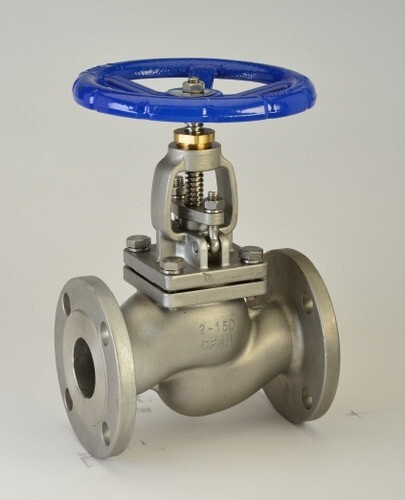
Common applications of globe valves include cooling water systems, bulk water and water treatment, plumbing and HVAC systems, boiler systems and oil and gas facilities. Examples include:
Steam Systems: Widely used in industrial facilities and power plants for controlling the flow of steam, due to their ability to handle high temperatures and high pressures.
HVAC Systems: Controls the flow of fluids, include water, steam, refrigerant and condensate, in heating, cooling, and ventilation applications.
Fuel Oil Systems: Used in fuel lines to control the flow of fuel to engines.
Water Supply and Treatment: Ideal for chemical dosing, filtration, pump station control and water distribution networks.
Globe Valves Optional Extras and Features
Globe valves may be specified with a range of optional features and accessories. These include bellow seals for zero stem leakage, low emission packing for environmental compliance, stem extensions for remote operation, locking devices for safety, actuator options, sanitary designs, a broad range of port configurations and end connections, and many materials of construction like brass, bronze, carbon steel and stainless steel to choose from.
Add image (actuated globe valve or extended stem)
Are Globe Valves the Right Control Valve for You?
Globe valves are the right valve for you, if your system needs accurate flow control over a broad flow range, while subjected to a high pressure drop across the valve. However if you are looking for minimal flow control capability in a valve, or if you are looking for a valve for isolation or shut-off functionality, then another valve like a ball valve, butterfly valve or gate valve might be the best option.
Our Posts
View All
Industrial Valves Used in Water Treatment Plants
Water treatment valves control flow rate, pressure, and direction of fluid flow in drinking water …
Read More
Industrial Control Valves: The Ultimate Guide for Engineers
Image courtesy of By Bitjungle - Own work, CC BY-SA 4.0 Precision flow control is vital to modern in …
Read More
What Are ANSI Standards for Valves and Are They Mandatory?
(And Why They Matter for Valve Systems) Whether you鈥檙e specifying valves for an oil refinery, water …
Read More
ASME Standards for Valves Explained: ASME vs. ANSI
On This Page What Is ASME? What Are Standards and Codes? Why ASME Standards Matter Key ASME Standa …
Read More
OSHA Pressure Relief Valve Regulations
OSHA pressure relief valve (PRV) regulations are extremely important for the safety of both your emp …
Read More
Choosing PVC vs Brass Ball Valves
When it comes to ball valves, there's no one-size-fits-all answer. PVC and brass are both excellent …
Read More
Agricultural Irrigation Maintenance Checklist
Here are some things to think about. If an agricultural irrigation pump has to work against just 5 p …
Read More
Agriculture Irrigation Valves: Efficient Flow Control for Farms
Agriculture irrigation valves are vital for efficient flow control, and valve selection is rarely ab …
Read More
Backflow Prevention Devices
According to the American Backflow Prevention Association, 24 gallons of asphalt emulsifier, intende …
Read More
Top 7 Swing Check Valves by Model & Manufacturer
Looking for reliable swing check valves? Discover the top 7 models from leading manufacturers like C …
Read More
What is a Spool Valve and How Does It Work?
Spool valves are incredibly useful. They are a simple directional control valve used in hydraulic an …
Read More
What is the cracking pressure of a check valve?
Check valves, regardless of their individual design, serve the specific purpose of permitting the fl …
Read More
Smart Water Valves: Futuristic Flow Control Technology
Leaks can range from annoying to devastating, and the longer they go unaddressed, the more costly th …
Read More
How to Calculate Flow Rate In Water Systems
Flow rate is critical in water systems, from simple home plumbing to complex industrial water system …
Read More
What Is a Valve Pressure Rating? Definition and Guide
Pressure ratings are important considerations when designing a system that uses valves, but they can …
Read More
Special Pricing and Services for OEM - the 91视频 Valve Store
OEMs or Original Equipment Manufacturers make up a large portion of our clients at 91视频. With th …
Read More
Data Cooling Centers and Sanitary Valves
Overheated data centers pose a massive challenge, and the global data center cooling market is growi …
Read More
Valve Maintenance Best Practice Guide
A Guide to Safer, Long Lasting Valves Valves are found in most piped systems that move liquids, gas, …
Read More
Valve Materials for Gaseous Oxygen Service
Oxygen may seem safe because it is colorless, tasteless, and odorless, but in the wrong conditions, …
Read More
Pneumatic Actuators Valve Types
Have you ever stopped to think about what makes an automated assembly line push, pull, lift, and rot …
Read More